Modern Kitchen Layout Ideas: Clean Lines, Clear Flow, and Practical Design
Why Layout Is the Backbone of a Modern Kitchen
In a modern kitchen, layout is not hidden behind decoration—it is the design. Clean lines, visual calm, and ease of movement all depend on how cabinets, appliances, and work zones are arranged.
Unlike traditional kitchens that rely on ornament to create interest, modern kitchens depend on proportion, alignment, and spatial logic.

Key Layout Principles in Modern Kitchen Design
Modern kitchen layouts are guided by a few essential principles:
- Clarity: Each zone has a clear purpose.
- Continuity: Cabinet lines flow without interruption.
- Efficiency: Movement between tasks is direct and intuitive.
- Visual balance: Elements are aligned and proportioned.
When these principles are respected, the kitchen feels effortless to use and calm to experience.
Open Modern Kitchen Layouts
Many modern kitchens are designed as part of an open-plan living space. In an open modern kitchen, layout must perform two roles at once: functional workspace and visual background.
- Cabinetry often aligns with living-room architecture
- Appliances are integrated to reduce visual noise
- Work zones are subtly defined rather than enclosed
This approach allows the kitchen to blend naturally into the surrounding space.
The Role of the Island in Modern Kitchens
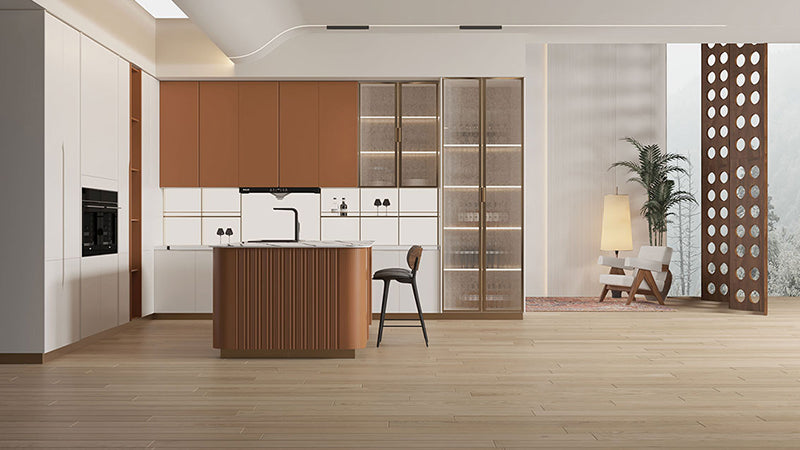
In modern kitchen ideas, the island is often the organizing element of the layout.
- Acts as a visual anchor
- Separates cooking and living areas
- Provides additional prep and storage space
Modern islands are typically simple in form, with flat surfaces and minimal detailing. Storage is concealed, and seating—if included—is integrated cleanly.
Linear and Parallel Layouts
Linear and galley-style layouts are common in modern kitchens due to their efficiency.
- Single-wall layouts: Ideal for apartments and compact spaces
- Parallel layouts: Offer strong workflow with minimal wasted movement
In both cases, upper cabinets are often reduced or replaced with tall storage to maintain visual openness.
Full-Height Cabinet Layouts for Visual Order
Modern kitchens frequently use full-height cabinets to create uninterrupted vertical lines.
- Appliances are concealed behind panels
- Pantry storage is integrated into tall units
- Upper gaps are eliminated for a built-in look
This approach reduces clutter and reinforces architectural simplicity.
Zone-Based Planning in Modern Kitchens
While modern kitchens look simple, their layouts are often highly structured.
- Prep zone: Clean surfaces and drawer-based storage
- Cooking zone: Integrated appliances and heat-resistant materials
- Cleaning zone: Minimal visual presence, high functionality
Each zone is designed to operate quietly in the background.

Modern Layouts and Storage Restraint
A key difference between modern and traditional kitchens is restraint.
Rather than filling every wall with cabinets, modern layouts:
- Use fewer, better-organized cabinets
- Prioritize drawers over deep cupboards
- Hide complexity behind simple surfaces
This restraint is what gives modern kitchens their signature calm.
Custom Layouts and Modern Kitchen Systems
Modern kitchen layouts often rely on precise cabinet proportions and alignment. Custom or semi-custom systems make it easier to achieve this level of control.
Some manufacturers, such as Goldenhome, approach modern kitchen planning as a coordinated system—aligning cabinet widths, island dimensions, and storage zoning early in the process. The emphasis is on consistency and long-term usability rather than visual impact alone.
Conclusion: Simplicity Is Designed, Not Accidental
A successful modern kitchen layout feels simple because it is carefully planned. When flow, storage, and proportion work together, the kitchen supports daily life without drawing attention to itself.
Modern kitchen design is not about doing less—it is about doing only what is necessary, and doing it well.