Kitchen Cabinet Trim and Ceiling-Height Cabinets: Designing a Seamless Built-In Kitchen
Why Ceiling-Height Cabinets Are Gaining Popularity
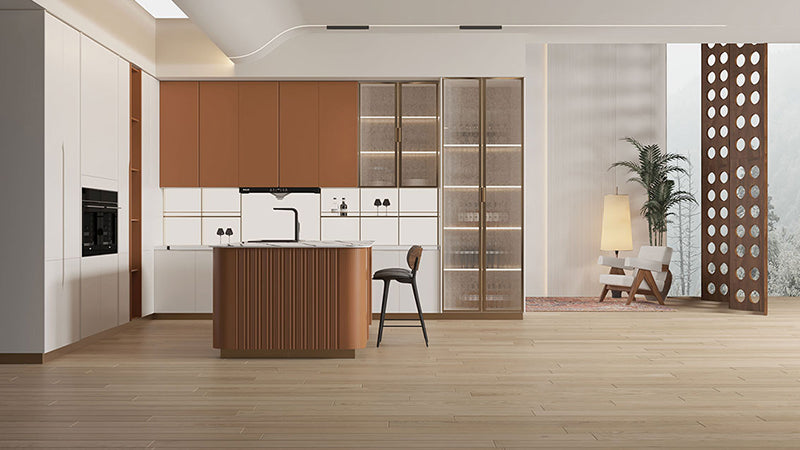
In modern kitchen design, ceiling-height kitchen cabinets have become increasingly popular. Extending cabinetry all the way to the ceiling creates a built-in appearance, maximizes storage, and reduces visual clutter caused by empty upper gaps.
However, achieving a refined result depends heavily on how kitchen cabinet trim is integrated—or intentionally minimized—within the design.

The Role of Trim in Full-Height Cabinet Designs
When cabinets reach the ceiling, trim shifts from a decorative role to a structural and proportional one. Rather than adding visual weight, trim helps resolve transitions and maintain clean alignment.
- It softens the junction between cabinet and ceiling
- It compensates for ceiling irregularities
- It reinforces vertical proportions
In ceiling-height designs, trim is often subtle—or even invisible—but never accidental.
Minimal Trim vs. No Trim: What Works Best?
One of the most common questions in full-height cabinetry is whether trim is needed at all.
- No trim: Works best in modern kitchens with flat ceilings and precise construction. Cabinets terminate cleanly at the ceiling for a crisp, architectural look.
- Slim crown or shadow gap: Provides tolerance for uneven ceilings while maintaining visual simplicity.
The choice depends on construction accuracy, ceiling conditions, and desired design expression.
Using Shadow Gaps as an Alternative to Traditional Trim
In contemporary kitchens, shadow gaps are often used instead of traditional cabinet molding. A shadow gap creates a deliberate recess between cabinets and ceiling, producing a refined, minimalist effect.
Benefits of shadow gaps include:
- Clean, modern aesthetic
- Reduced visual bulk
- Consistent lines across tall cabinet runs
This approach requires precise planning and manufacturing accuracy.
Trim Strategies for Uneven Ceilings
Even in high-end homes, ceilings are rarely perfectly level. In these cases, trim becomes a practical design solution rather than decoration.
- Slim crown molding can absorb height variation
- Scribe molding ensures tight fits along irregular surfaces
- Painted trim blends transitions seamlessly
Ignoring ceiling conditions often results in visible gaps that undermine the built-in effect.
Color Matching for Seamless Cabinet-to-Ceiling Transitions
Color plays a critical role in how trim is perceived in ceiling-height cabinets.
- Matching cabinet and trim color: Creates continuity and visual calm
- Matching ceiling color: Softens transitions in minimalist kitchens
- High-contrast trim: Rarely recommended in full-height designs due to visual interruption
In most cases, subtlety delivers the most sophisticated result.
Custom Cabinet Systems and Trim Coordination
Full-height cabinetry demands a higher level of coordination between cabinet proportions, door styles, and trim details. This is why ceiling-height kitchens are often executed using custom or semi-custom cabinet systems.
Some large-scale manufacturers, such as Goldenhome, design cabinet systems where trim options, filler tolerances, and ceiling transitions are considered during early planning stages. The benefit lies not in decoration, but in achieving consistency across tall cabinet elevations.

When Trim Should Be Eliminated Entirely
In certain kitchens, the most refined choice is to eliminate trim altogether.
- Ultra-modern kitchens with flat slab doors
- Spaces emphasizing architectural minimalism
- Projects with precise ceiling construction
In these cases, cabinetry becomes an architectural surface rather than furniture.
Conclusion: Refinement Through Proportion, Not Decoration
In ceiling-height kitchens, kitchen cabinet trim must be approached with restraint and intention. Rather than adding visual interest, trim supports proportion, alignment, and continuity.
When cabinet height, ceiling conditions, and trim strategy are planned together, the result is a kitchen that feels integrated, calm, and timeless—where the design speaks through precision rather than ornament.